
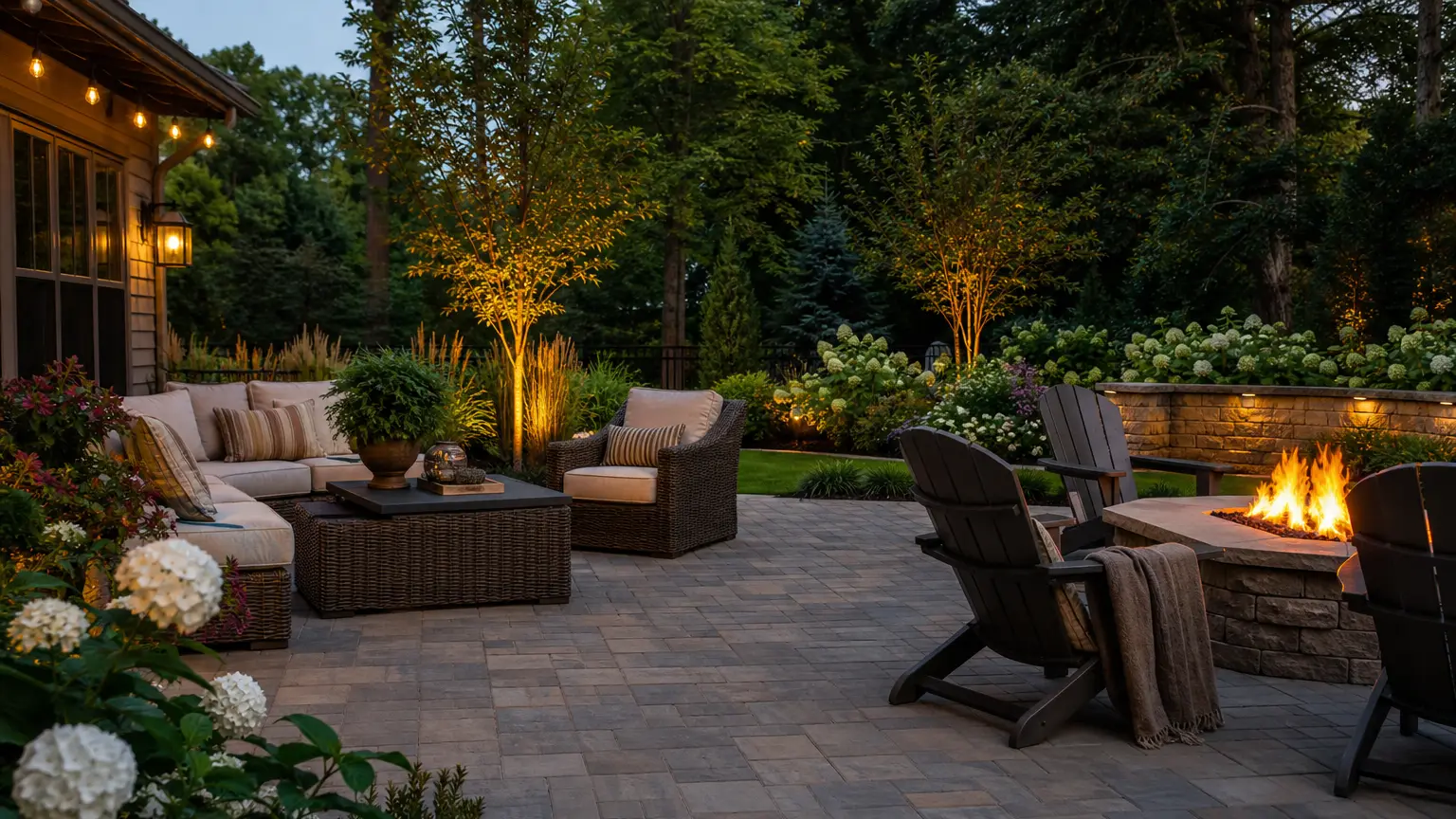
In most cases, paver patios cost Michigan residents between $17 and $25 or more per square foot, depending on complexity. That price covers the entire process — excavation and base, laying the pavers, and the finishing work — which puts an average project in the range of $5,000 to $9,000. Pricing for a specific project varies with the exact scope of work.
Adding a patio is one of the more reliable ways to improve how a property looks and how much of it you actually use. It is also a project where two quotes for the same square footage can differ by thousands, because most of the real work in paver patio installation happens below the surface. This guide covers what moves the number in Southeast Michigan specifically, what is included in a proper installation, and the site conditions that turn a straightforward patio into a bigger hardscape project.
What does a paver patio cost per square foot?
The working range here is $17 to $25 or more per square foot for a complete installation. A 300-square-foot patio — a common size for a table, chairs, and a grill — sits toward the lower end of the total-cost band. A 600-square-foot patio with a defined dining area and a separate seating area sits toward the upper end or past it.
The per-square-foot figure falls slightly as patios get larger, because mobilization, excavation setup, and disposal are spread over more area. It rises when a patio is small but detailed, since cuts and edges are where the labor concentrates and a small patio is almost all edge.
How does size affect the price of a paver patio?
Depending on the size of your patio area, the volume of material and the number of labor hours can differ substantially. That makes sizing the most direct budget lever you have. The useful exercise is furniture-first: lay out the table, the chairs pushed back, the grill, and the walking room around them, and size the patio to that rather than to a round number.
Oversizing is the most common budget mistake we see, and it is expensive in two directions — more square footage now, and more surface to sweep, weed, and maintain later. Undersizing is the second most common. A patio that cannot hold a table with chairs pulled out gets used less, which is the worst outcome for the money.
How much does design complexity add?
Contractors can create striking designs by installing pavers in varied patterns and shapes, but that complexity also increases costs. Finding the balance between aesthetic appeal and affordability is a real part of planning the project.
The reason is simple: complexity means cuts. A herringbone field costs more to lay than a running bond. Curves cost more than straight runs. A contrasting border or soldier course adds material and a full pass of cutting. Circle kits, inlays, and multi-color patterns each multiply the detail labor.
If the budget is tight, a straightforward field with a single contrasting border delivers most of the visual effect for a fraction of the added cost — and it is easier to extend later if you decide to grow the space.
What does the terrain do to the cost?
Installing a paver patio is straightforward work for an experienced crew, but it is nearly impossible to do well without level ground. Homeowners looking to install a paver space on a sloped area will need the ground leveled, and usually a retaining wall installed, before construction of the patio begins. That work has to be accounted for in the budget.
This is the single most common reason a patio quote comes back higher than expected. A yard that falls away from the house needs either cut-and-fill grading or a retaining wall to create the level pad — and a wall is a structural element with its own cost basis. Our retaining wall cost guide covers what that side of the project runs.
Access is the other terrain factor. If a skid steer can reach the backyard, excavation and material handling take hours. If everything has to move through a gate by wheelbarrow — common on older lots in Royal Oak, Clawson, and Grosse Pointe — the same work takes days, and the labor line reflects it.
Why does the base matter so much in Southeast Michigan?
Nearly every failed paver project in this region traces back to one of two things: not enough compacted base, or a surface pitched so water pools instead of draining. Freeze-thaw finishes the job over a few winters — heaving, settling, and separating joints.
Southeast Michigan's winters put a patio through dozens of freeze and thaw cycles a year. Water that sits in or under the installation expands as it freezes and lifts whatever is above it. The defenses are a properly excavated and compacted base, a surface pitched to shed water away from the house, and joints filled with polymeric sand so water runs off rather than in.
Heavy clay soil, common across Macomb and eastern Oakland County, makes this more demanding rather than less. Clay holds water, so a patio built on clay needs the base and the pitch handled deliberately. That is the part of the job that never shows in a photo and always shows in year five.
What is included in a paver patio installation?
A complete installation covers excavation to the depth the project calls for, base material compacted in lifts and set to the right slope, laying the pavers to the design pattern with cuts to fit, a soldier course around the edges, and edge restraint that locks the perimeter so the field cannot spread over time.
Finishing is polymeric sand swept into the joints, the surface blown clean, and the sand set with a light mist of water, allowed to dry, and misted again. Within 24 to 48 hours of drying the patio is ready to use.
When you compare quotes, compare those specifics — excavation depth, base material, compaction method, edge restraint, and joint sand. Square footage and paver style are the easy things to match; the build spec is where the difference in price usually lives.
What else should be in the budget?
A patio looks good on its own, but no outdoor living area is really complete without the surrounding work that ties it into the landscape. That includes planting shrubs and ornamental trees, landscape rock or mulch, edging, and lighting — the elements that make a backyard feel finished rather than installed.
Outdoor lighting is worth deciding on early even if it comes later, because conduit is far easier to run before the pavers go down than after. The same is true for a gas line to a future grill or fire feature.
Fire features, seat walls, and outdoor kitchens are the usual add-ons, and each one changes the scope enough that it belongs in the conversation at design time rather than mid-build.
Common questions
- How much does a paver patio cost in Southeast Michigan?
- Most paver patios run $17 to $25 or more per square foot for a complete installation, which puts a typical project around $5,000 to $9,000. The figure covers base preparation, laying the pavers, and finishing work; pricing varies with the exact scope.
- Is a paver patio cheaper than a concrete slab?
- A poured slab is usually less expensive up front. Pavers cost more to install and generally last longer in freeze-thaw conditions, and a settled section can be lifted and re-set rather than cut out and repoured, which is where the long-run comparison changes.
- Do I need a retaining wall for my patio?
- Only if the ground is sloped. A patio needs a level pad, so a yard that falls away from the house needs either grading or a retaining wall to create it. We identify which one your site needs during the site visit, before quoting.
- How long does it take to build a paver patio?
- Most residential patios run a few days to about a week on site, depending on size, access, and how much excavation the grade requires. Projects that include walls, steps, or lighting take longer.
- When is the best time of year to install a paver patio in Michigan?
- Anytime the ground is workable, which is roughly spring through late fall in Southeast Michigan. Spring is the busiest season, so scheduling earlier in the year usually means a shorter wait for an install date.
- What maintenance does a paver patio need?
- Very little. Rinse it, pull weeds if any appear in the joints, and top up polymeric sand every few years. Individual pavers can be lifted and re-set if a section settles.