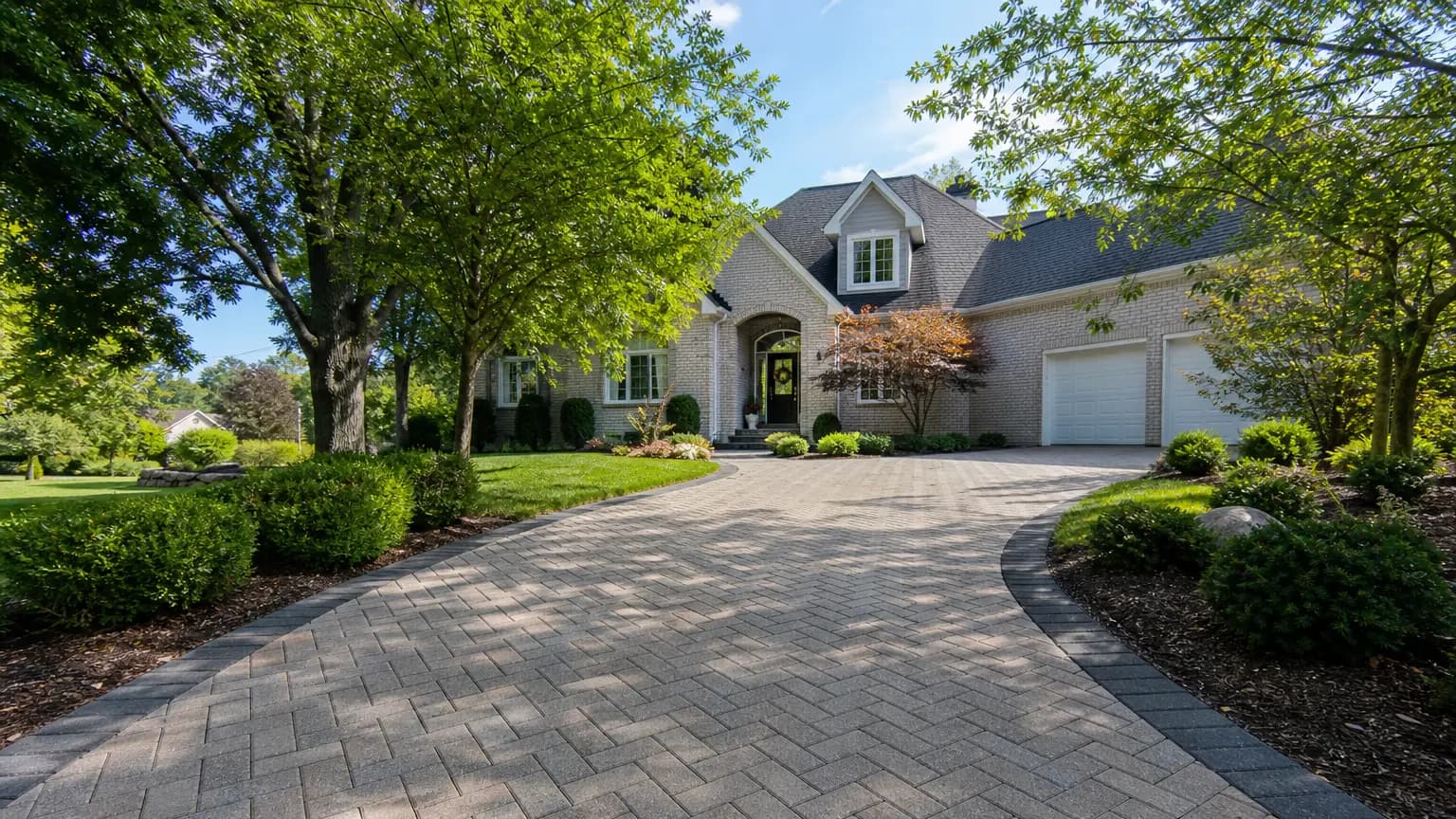
Paver driveways in Metro Detroit typically cost between $18 and $50 per square foot for complete installation. For an average 750-square-foot suburban driveway, that works out to roughly $7,500 to $33,750+ depending on the material you choose and how complex the design is. Those figures cover the whole job — materials, labor, site preparation, and finishing work — not just the pavers sitting on a pallet.
That is a wide band, and the reason is that a driveway is a structure, not a surface. Most of the cost of paver driveway installation is buried below what you ever see: excavation depth, compacted base, and drainage that has to survive Southeast Michigan's freeze-thaw cycle year after year. This guide breaks the number down by material, by project size, and by the site conditions that move it — so you can tell the difference between a quote that is genuinely cheaper and one that is skipping the part that makes a driveway last. If you are weighing several projects at once, the rest of our hardscape and outdoor living work follows the same build standard.
How much does a paver driveway cost per square foot?
Across Metro Detroit, complete paver driveway installation runs $18 to $50 per square foot. Where a specific project lands inside that range comes down to three things: the paver material, the amount of excavation and base the soil calls for, and how much cutting the layout demands. A straight rectangular drive in a standard running bond pattern sits near the bottom of the range. A curved drive with a border course, an inlaid apron, and radius cuts sits near the top.
It helps to think of the price in two halves. Roughly speaking, the visible half is the paver itself and the pattern it is laid in. The invisible half is excavation, base stone, compaction, edge restraint, and drainage — and that half barely changes whether you pick the least expensive concrete paver or the most expensive cobblestone. That is why the cheapest quote in a stack is worth reading carefully: the savings usually come out of the half you cannot inspect once the job is done.
Paver driveway cost by material
Concrete pavers are the most budget-friendly option at $20 to $30 per square foot installed. They are manufactured to consistent dimensions, come in a wide range of colors and finishes, and hold up well to Michigan weather. Consistent sizing also means faster laying and less waste, which is part of why they price lower.
Brick pavers run $20 to $45 per square foot installed. Clay brick has a classic look that suits older Grosse Pointe and Birmingham housing stock, and it performs exceptionally well through freeze-thaw conditions because the color runs through the whole unit rather than sitting on the surface.
Natural stone — granite, limestone, sandstone — costs $20 to $60 per square foot installed. Every piece is different, which is the appeal, but it also means more hand-fitting on site and more labor in the number.
Cobblestone is the premium end at $25 to $50 per square foot installed. It is the most durable option in the group and carries a European look that nothing else quite reproduces, at the cost of the slowest installation in the category.
What does a paver driveway cost by project size?
A single-car driveway of roughly 300 square feet generally runs about $7,500 to $13,500 installed, depending on material.
An average suburban driveway around 750 square feet lands near $15,000 to $22,500 in concrete pavers, $18,000 to $30,000 in brick, or $22,500 to $37,500 in natural stone.
A large estate driveway of 1,000 square feet or more ranges from $20,000 to $30,000+ in concrete pavers, $24,000 to $40,000+ in brick, and $30,000 to $50,000+ in natural stone.
What drives the cost of a paver driveway in Southeast Michigan?
Freeze-thaw is the local variable that changes everything. Between roughly November and April, water in the ground under a driveway freezes, expands, and thaws repeatedly. A driveway built on inadequate base rides that movement — it heaves in spots, settles in others, and opens joints that then take on more water. The fix is not a better paver; it is more base and better drainage, and that is labor and stone.
Base depth is the single largest hidden cost. A patio can be built on a shallower base because it only ever carries people and furniture. A driveway carries vehicles, and in Southeast Michigan it carries them over saturated spring ground. Driveways get a deeper excavation and more compacted aggregate than a patio for exactly that reason, and any quote that prices a driveway on a patio spec is quietly borrowing against the life of the installation.
Soil and drainage come next. Much of Macomb and eastern Oakland County sits on heavy clay, which holds water instead of shedding it. Clay under a driveway means more excavation, more stone, sometimes geotextile fabric to keep the base and the subgrade from mixing, and a drainage plan that moves water somewhere deliberate. If the grade runs toward the house or the garage slab, that has to be corrected before pavers go down — often alongside drainage solutions elsewhere on the property.
Site access affects the labor line more than most homeowners expect. A front driveway a skid steer and a dump truck can reach directly is the least expensive scenario. Tight side yards, narrow lot lines, mature trees to protect, or an existing surface that has to be broken out and hauled away all add hours. Removing an old concrete or asphalt drive is its own line item, and disposal is priced by weight.
Design complexity is the last lever, and the one you control. Curves, circle kits, contrasting border courses, and inlaid patterns can add 20% to 40% to a project because every one of them multiplies the cuts. If budget matters more than intricacy, a simple field with a single soldier-course border gives you most of the visual payoff for a fraction of the added labor.
What is included in a paver driveway estimate?
Metro Detroit paver driveway pricing normally includes excavation, base preparation appropriate to Michigan soil conditions, drainage, paver installation, edge restraints, joint sand, and site cleanup. Those are the components that make the installation a driveway rather than a decorative surface, and they should be itemized rather than bundled into one number.
When you compare quotes, compare those items directly — excavation depth, base material, whether it is compacted in lifts, edge restraint, and joint sand. Two quotes at the same square footage with a large gap between them are usually not quoting the same job.
For a walkthrough of the sequence we follow on site, from excavation through joint sand, see our paver installation page.
Is a paver driveway worth it compared to asphalt or concrete?
Pavers cost more up front than asphalt or poured concrete. The case for them is durability and repairability. Over 30 years, a typical Michigan driveway might need several asphalt or concrete replacements, which is what makes pavers the more economical choice across the long run rather than the short one.
Repairability is the underrated part. When poured concrete cracks — and in this climate it eventually does — the fix is cutting out and replacing a slab section, and the patch never matches. When a paver section settles, individual units lift out, the base underneath is corrected, and the same pavers go back down. From the curb, the repair is invisible.
There is also a resale argument. A paver driveway is the first thing visible from the street, and in neighborhoods across Troy, Rochester Hills, Bloomfield Hills, and Birmingham it reads as a finished property rather than a maintained one. That is not a number we would put a figure on, but it is a real part of why homeowners choose it.
How long does a paver driveway take to install?
Most residential driveways are a multi-day project. The sequence is demolition and haul-away if there is an existing surface, excavation to depth, base installation compacted in lifts, screeding, laying and cutting, edge restraint, and finally polymeric sand set with a light mist of water. Weather matters — base compaction and joint sand both want dry conditions.
Common questions
- How much does a paver driveway cost in Metro Detroit?
- Complete installation typically runs $18 to $50 per square foot. For an average 750-square-foot suburban driveway that is roughly $7,500 to $33,750+, with the spread driven mainly by material choice and design complexity.
- Are paver driveways cheaper than concrete?
- Not up front — pavers cost more to install than poured concrete or asphalt. The long-run comparison is different: over about 30 years a typical Michigan driveway may need several asphalt or concrete replacements, and settled pavers can be lifted and re-set rather than torn out and repoured.
- Do paver driveways hold up to Michigan winters?
- Yes, when the base is built for it. Freeze-thaw failure is a base and drainage problem, not a paver problem. Driveways need a deeper compacted base than patios because they carry vehicle loads, plus a surface pitched so water drains off instead of pooling.
- Can pavers be installed over an existing concrete or asphalt driveway?
- We do not recommend it for driveways. The old surface hides whatever is failing underneath, and the drainage and base conditions that determine how long the new installation lasts cannot be corrected through it. Removal and haul-away is a separate line item on the estimate.
- How much maintenance does a paver driveway need?
- Very little. Rinse it, pull any weeds that appear in the joints, and top up polymeric sand every few years. If a section ever settles, individual pavers can be lifted, the base corrected, and the same units re-set.